
ECFVG Registration: A Step-by-Step Guide for International Veterinarians
Registering with the Educational Commission for Foreign Veterinary Graduates (ECFVG) is an important step for many internationally trained veterinarians pursuing US licensure. Preparing your documents before submitting the application can prevent avoidable delays.
Before you apply: confirm your pathway
Check your veterinary school in the AVMA directory of ECFVG-listed colleges. Being listed is different from being AVMA-accredited. If your school is absent, review the school-listing procedure before applying.
Also check the licensing requirements of your intended US state or territory. ECFVG certification establishes educational equivalence; it is not a licence to practise. The NAVLE and any additional jurisdiction requirements are separate.
1. Prepare your documents before submitting the application
The deadline is tied to submitting the online application, not simply creating an account. AVMA requires the initial application documents to be received within 10 calendar days of submitting the online application. Arrange notarization and any necessary delivery in advance. See the official ECFVG steps and submission instructions.
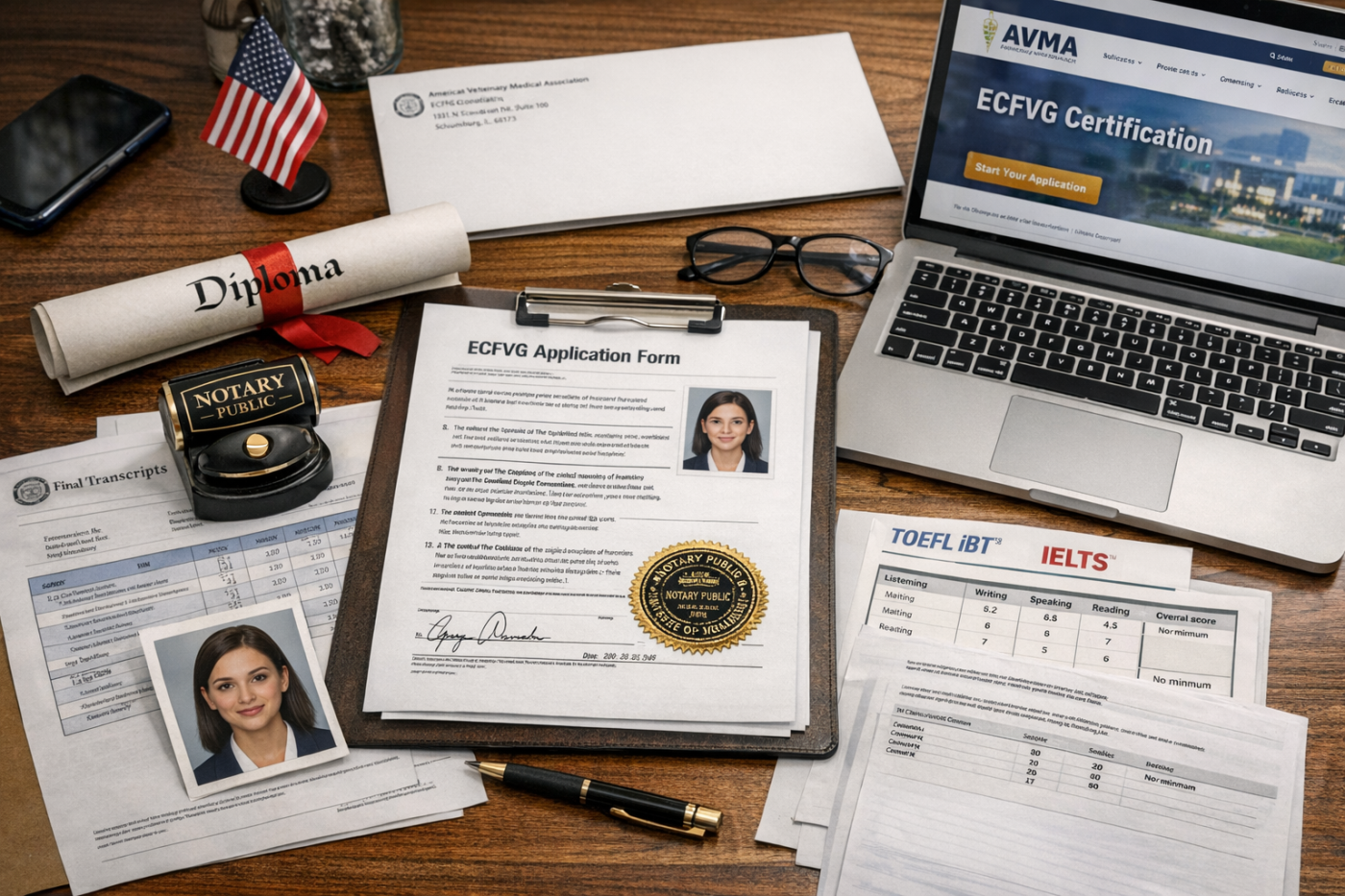
- Application form: save the form supplied at the end of the online application. All required pages must be notarized.
- Photograph: a recent colour, full-face photograph taken within the preceding 30 days, measuring 2 × 2 inches. Follow the US passport photograph requirements.
- Diploma: a PDF of the final veterinary diploma in its original language, with a certified English translation when necessary. A provisional certificate or certificate of schooling does not replace the final diploma.
- Transcripts: PDFs of final transcripts for each year of study, in the original language and with certified English translations when necessary. A course list alone is insufficient.
Keep readable copies and use your name consistently across your application and identification. If the university issues documents in both its original language and English, submit both versions as directed by AVMA. Do not substitute your own translation for a required certified translation.
2. Complete the online application and arrange payment
Use the official ECFVG portal, record your candidate ID, and save the application form immediately. The published initial registration total is US$1,600 for 2026; AVMA has announced US$1,800 for 2027. These registration fees do not include examination fees. Recheck the official fee information before paying.
Credit-card authorization and payment processing are separate: AVMA states that the card payment is processed after the notarized application form is approved. Monitor your account and email for any further payment instructions.
3. Notarize and submit the application form
Online notarization
NotaryCam is the online notarization provider accepted by ECFVG. Follow the AVMA NotaryCam instructions for preparing the form, photograph and appointment. NotaryCam submits the notarized form directly to ECFVG.
In-person notarization
If you use an eligible in-person notary, follow the instructions printed on the application. Attach the photograph before notarization. The seal or stamp must cover part of the photograph and part of the form; if local law prohibits this, AVMA requires the notary's signed, dated official explanation.
The original notarized form must be delivered by physical mail to:
American Veterinary Medical Association
Attn: ECFVG
1931 N Meacham Road, Suite 100
Schaumburg, IL 60173-4360
USA
Allow for delivery within the application deadline. An emailed scan does not replace the required original in this submission route.
4. Send the educational documents and track verification
Email the required diploma and transcript PDFs to ECFVG@AVMA.org, including your full name and ECFVG ID. These educational PDFs follow a different submission route from the notarized application form.
ECFVG separately contacts your veterinary college to verify your identity and graduation. This can take weeks or months, so ask your university which office handles verification requests and follow up appropriately. Sending documents does not mean that credential verification is complete.
After approval of the notarized application and processing of payment, candidates can progress through the permitted language and BCSE steps while school verification is pending. Completion of the required earlier steps, including credential verification, is necessary before the CPE. Check your account for your individual status.
What if you are in your final year?
ECFVG provides a final-year student route. Instead of a diploma that has not yet been awarded, submit transcripts for completed years and arrange for your school to send an English-language letter directly to ECFVG confirming that you are expected to graduate within the year. Submit the final diploma and final transcripts after graduation, with the required translations.
5. Meet the ECFVG English-language requirement
Language verification is Step 2 and must be completed before the BCSE. The table below summarizes the minimum scores in AVMA's current policy. Use the row that matches your TOEFL test date.
| Test | Listening | Writing | Speaking | Reading | Overall |
|---|---|---|---|---|---|
| TOEFL iBT taken before 21 January 2026 | 25 | 22 | 22 | 23 | No separate minimum |
| TOEFL iBT taken on or after 21 January 2026 | 5 | 4.5 | 4.5 | 4.5 | No separate minimum |
| IELTS Academic | 6.5 | 6 | 7 | No separate minimum | 6.5 |
| CAEL | 60 | 50 | 60 | No separate minimum | 60 |
Complete all test sections and meet the required scores in one administration. Follow AVMA's rules on accepted test formats, official score reporting and score age; reports must generally be no more than two years old when verified. Complete the Step 2 submission form in your ECFVG account so the evidence can be processed.
Can the language examination be waived?
The ECFVG secondary-school route requires evidence of at least three years of full-time secondary education taught entirely in English in the United States, United Kingdom, Australia, New Zealand, or Canada outside Quebec. The school must provide the required confirmation directly. An English-taught veterinary degree alone does not satisfy this ECFVG waiver. This differs from the Canadian NEB policy.
Before moving on
- Check which documents are received, approved or still awaiting verification.
- Keep copies of submissions, payment records and correspondence.
- Plan for registration renewal and the time limits between ECFVG steps.
- Use the current candidate bulletin for each examination rather than assuming that registration confirms exam eligibility.
Related reading: Common ECFVG registration mistakes and our comparison of international veterinary licensing pathways.